
 Welcome, Guest Blogger

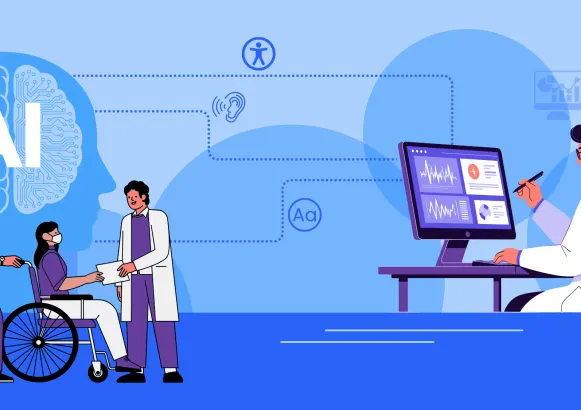
This post will focus on the following topics.
- The Rising Pulse of Accessibility in Healthcare Documentation
- Understanding the Accessibility Barriers in Healthcare Documents
- Why Accessible Documents Are Crucial for Compliance and Care
- The AI Revolution in Healthcare Document Accessibility Services
- Automating the Complex Art of Healthcare Document Remediation
- AI-Driven Accessibility Enhancing Patient Communication
- Real-World Impact: Success Stories in AI-Powered Healthcare Accessibility
- Scalability and Efficiency in Healthcare Remediation
- Choosing the Right Partner for Healthcare Document Accessibility
- Blending Technology and Human Expertise for Better Healthcare Accessibility
The Rising Pulse of Accessibility in Healthcare Documentation
In today’s digital healthcare world, document accessibility has become essential. It’s not about meeting the legal requirements now, it’s also about helping every patient even with disabilities to read, understand, and act on their health information. Whether it’s a prescription, discharge summary, or insurance form, accessible documents help everyone,
Understanding the Accessibility Barriers in Healthcare Documents
Every day, hospitals and healthcare organizations produce a huge number of digital documents like reports, test results, forms, etc. But many of these aren’t easy to access for people who rely on screen readers or assistive tools. If there are poorly tagged PDFs, images without descriptions, and confusing layouts make it difficult for users with disabilities to understand the information.
These gaps in healthcare document remediation affect both patient experience and compliance with accessibility standards such as WCAG, PDF/UA, and HIPAA. When documents aren't accessible, it can lead to misunderstanding medical instructions or even delay treatment but these issues can be avoided with the right document accessibility services.
Research from the World Economic Forum emphasizes that over half of the world's population—4.5 billion people—still lack access to essential healthcare services, highlighting the critical need for digital accessibility solutions.
Why Accessible Documents Are Crucial for Compliance and Care
Making healthcare documents accessible is to improve patient experience. When patients can easily understand their records, they can make better health decisions.

Accessible records also support HIPAA-compliant document accessibility, ensuring that sensitive information is protected while remaining readable for everyone. For organizations, it’s a smart way to meet regulations while showing real care for patient needs.
To understand how both automated and manual methods can work together, check out this blog on automated vs. manual document remediation. It explains how combining technology with human review creates better, more reliable accessibility results.
The AI Revolution in Healthcare Document Accessibility Services
Artificial Intelligence (AI) is transforming how healthcare organizations handle document accessibility. Through AI-powered document remediation, automation speeds up the process of fixing inaccessible PDFs and other files while maintaining accuracy.
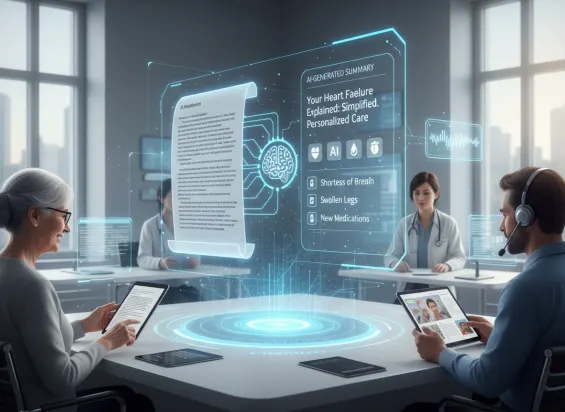
Key technologies like Optical Character Recognition (OCR), Natural Language Processing (NLP), and Machine Learning (ML) work together to detect text, identify structure, and understand document meaning. This helps ensure compliance with PDF accessibility in healthcare standards while reducing manual work.
According to Deloitte research, 53% of consumers believe AI can improve healthcare accessibility, and about 60% of healthcare leaders using generative AI are already seeing positive returns on their investment. These tools don't replace human experts but they help them.
The result is faster, more consistent, and scalable automated healthcare document accessibility that helps healthcare providers reach every patient effectively.
Automating the Complex Art of Healthcare Document Remediation
Healthcare documents are often complicated, filled with tables, medical charts, and images. Doing this work manually is slow and error-prone.

If we use AI, then Ai can automatically add headings, tags, and alt-text for images while ensuring the content meets WCAG and PDF/UA guidelines. It also updates metadata to make files easier for assistive technologies to read.
But, AI is not always correct and human review is required. When industry experts review the AI’s work, the final documents meet both compliance standards and user expectations. This blend of technology along with human expertise creates reliable healthcare document remediation.
AI-Driven Accessibility Enhancing Patient Communication
With AI, healthcare providers can easily create AI-generated accessible formats such as audio versions, simple text summaries, and translations.

For example, a patient who is visually impaired can listen to their medical report, while another can read a simplified version of complex instructions. These solutions improve patient communication accessibility and make healthcare information more inclusive for all users.
Hospitals and insurance providers are already using AI to create accessible forms and reports, improving communication for patients with disabilities and different language needs.
Real-World Impact: Success Stories in AI-Powered Healthcare Accessibility
The transformation brought by AI-powered document remediation isn't just theoretical. Healthcare organizations across the country are already seeing remarkable results from implementing automated accessibility solutions.

Large hospital systems have reported processing thousands of patient documents in weeks rather than months, dramatically reducing their compliance backlogs. One regional healthcare network reduced their document remediation time by 75% while maintaining higher accuracy standards than manual processes alone could achieve.
Insurance providers have found particular value in AI accessibility tools when handling policy documents and claims forms. By automating the initial remediation process, they've been able to ensure that critical information reaches all policyholders, regardless of their abilities.
This has led to fewer misunderstandings, reduced customer service calls, and improved satisfaction scores among patients with disabilities.
Community health centers serving diverse populations have leveraged AI to create multilingual accessible documents, breaking down both language and accessibility barriers simultaneously. This dual approach has proven especially valuable in underserved communities where patients may face multiple challenges in accessing their healthcare information.
The measurable outcomes speak for themselves: faster document turnaround times, consistent quality across all materials, reduced legal compliance risks, and most importantly, better patient outcomes through improved information access. McKinsey research reveals that nearly 90% of health system executives report that digital and AI transformation is a high priority for their organizations, underscoring the widespread recognition of these technologies' value.
Scalability and Efficiency in Healthcare Remediation
The healthcare industry produces massive volumes of documents from patient histories to policy updates. Doing all the accessibility work manually isn’t possible as it takes too much time and effort.

With the help of automation, organizations can process thousands of files quickly and accurately. This makes document accessibility services scalable and consistent and reduces costs and turnaround times.
By combining automation with human expert review, healthcare providers ensure that accessibility standards are met efficiently across all digital content.
Choosing the Right Partner for Healthcare Document Accessibility
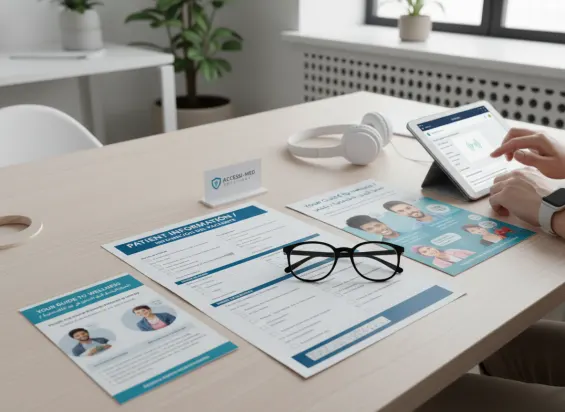
- Have experience in AI-powered document remediation and healthcare document remediation
- Follow accessibility standards like WCAG, PDF/UA, and HIPAA
- Offer transparency in their process
- Integrate AI accessibility tools smoothly with healthcare systems
- Provide long term support and maintenance
Blending Technology and Human Expertise for Better Healthcare Accessibility
The future of AI in healthcare compliance depends on AI and skilled human expertise. AI provides speed and structure, while human professionals bring understanding and context.

Together, they help build inclusive healthcare communication ensuring that every patient, regardless of ability, can access and understand their health information with ease. As healthcare continues to evolve in the digital age, the commitment to accessibility must remain at the forefront of innovation.
Organizations that prioritize accessible documentation today are not just meeting regulatory requirements—they're building stronger relationships with their patients and communities.
The investment in AI-powered document accessibility pays dividends beyond compliance. It reduces operational inefficiencies, minimizes the risk of miscommunication, and demonstrates a genuine commitment to patient-centered care. Healthcare providers who embrace these technologies position themselves as leaders in inclusive healthcare delivery, setting new standards for the industry.
In a world driven by data, true progress means making information available to everyone. By embracing automated healthcare document accessibility, healthcare providers strengthen trust, compliance, and care quality ensuring that no patient is left behind. The path forward is clear: accessible healthcare documentation is not optional—it's essential for delivering equitable, high-quality care in the modern healthcare landscape.
Read Next
The following articles are related to how ai is revolutionizing healthcare document accessibility.